
Battery Packs Cost Money Even While They Sleep: The Overlooked Profit Risk in Storage Maintenance
From production-line completion to vehicle installation or commissioning at an energy storage site, a battery pack typically spends 3-6 months in storage. Energy storage spare parts may remain in inventory for six months or even a year. Batteries, however, are never truly static. Self-discharge, calendar aging, temperature fluctuations, and cell imbalance continuously erode usable capacity. Industry data show that poorly managed batteries can experience capacity degradation at 2-3 times the normal rate. For battery manufacturers and energy storage operators, storage maintenance is not an optional enhancement; it is a critical process that directly affects aftermarket costs and profitability.
1. Three Core Pain Points During Battery Storage
Pain Point 1: Hidden capacity loss. Lithium-ion batteries continue to self-discharge during storage. If cell consistency is poor, the SOC of some cells can decline rapidly, causing pack voltage imbalance. After installation, the pack may fail to meet capacity requirements, trigger BMS alarms, or even become inoperable. By the time the issue emerges, tracing its cause can be extremely costly.
Pain Point 2: Gaps in safety monitoring. Warehouses may have smoke alarms and video surveillance, but they often lack a routine inspection mechanism focused on the batteries themselves. Thermal runaway is commonly preceded by warning signals such as declining insulation resistance, rising internal resistance, and abnormal temperatures, which conventional warehouse management methods cannot detect.
Pain Point 3: Missing lifecycle data. Without systematic records of battery condition at inbound and outbound stages, failures during the warranty period cannot be clearly attributed to manufacturing quality, storage maintenance, or field use, making responsibility difficult to determine.
2. The RePower Solution: Hardware Testing and Data Management to Protect Battery Value in Storage
Shenzhen RePower Industrial Co., Ltd. (RePower) has specialized in battery testing for more than two decades. For storage maintenance, RePower provides portable charge/discharge maintenance equipment, portable EOL test equipment, and portable energy storage safety inspection equipment, supported by data management capabilities that automatically archive test records, connect inventory ledgers, and enable traceability.
2.1 Charge/Discharge Activation and Maintenance Equipment: Periodic Wake-Up and Balancing Restoration
To meet the need for periodic activation of stored batteries, RePower offers two portable charge/discharge maintenance units covering both battery modules and complete packs.
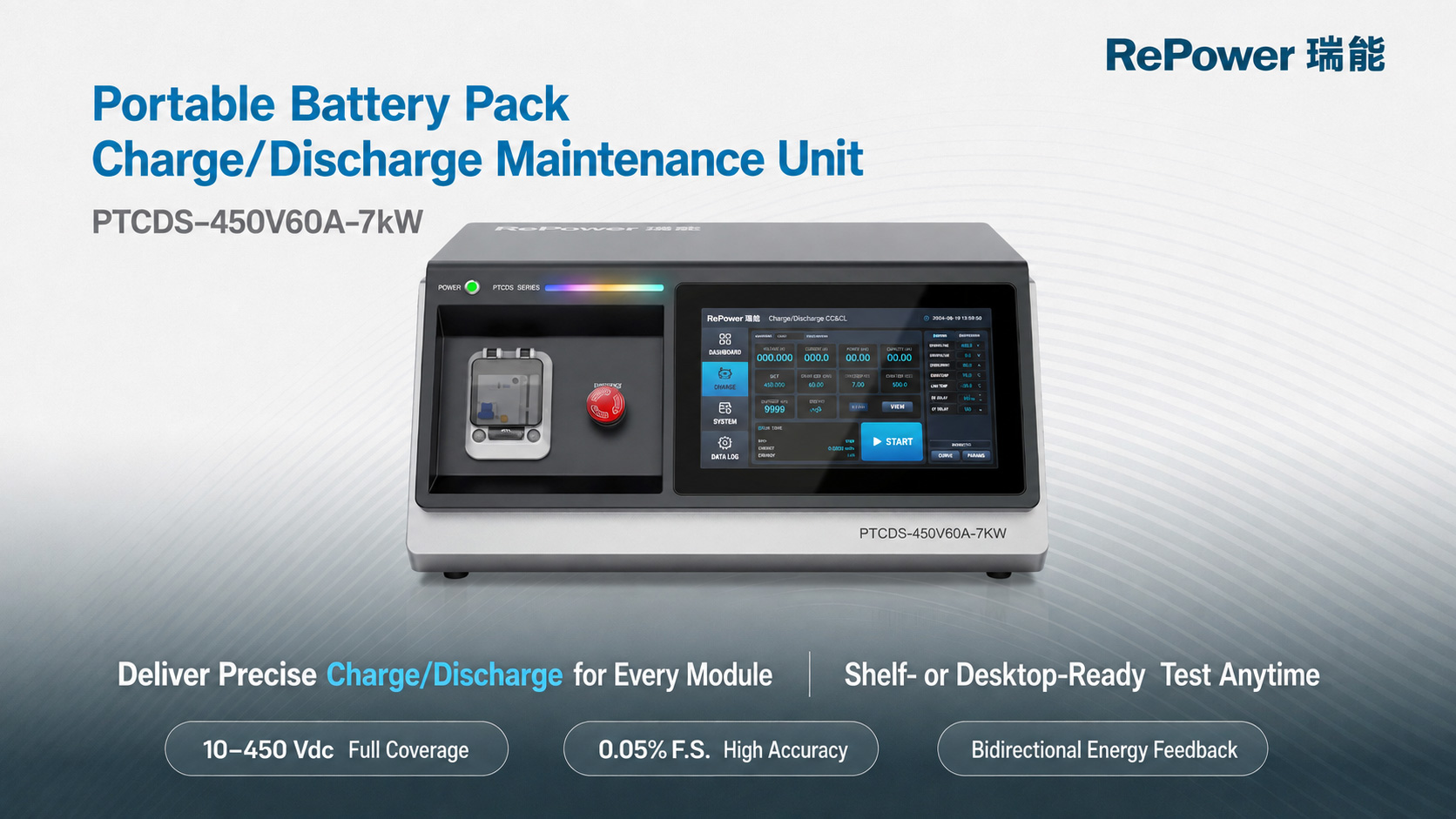
RePower Portable Battery Module Charge/Discharge Maintenance Unit (module/low-voltage pack level): Designed for charge/discharge maintenance at the battery module level, this unit covers an output voltage range of 10Vdc to 450Vdc and supports a wide variety of battery module voltage platforms. Test accuracy reaches 0.05%F.S., ensuring accurate and consistent capacity evaluation data. Its bidirectional power conversion technology feeds energy back to the grid during discharge, significantly reducing the electricity cost of long-term activation and maintenance. The unit operates on single-phase 220V power and can be plugged directly into a warehouse or workshop outlet without electrical infrastructure upgrades. Its compact footprint allows flexible use beside storage racks or on a workbench without occupying a fixed workstation. CAN communication testing provides real-time access to module status information for battery balancing and fault restoration. Test data can be stored internally or exported via a USB drive, supporting equipment ledger creation, record archiving, and traceability.
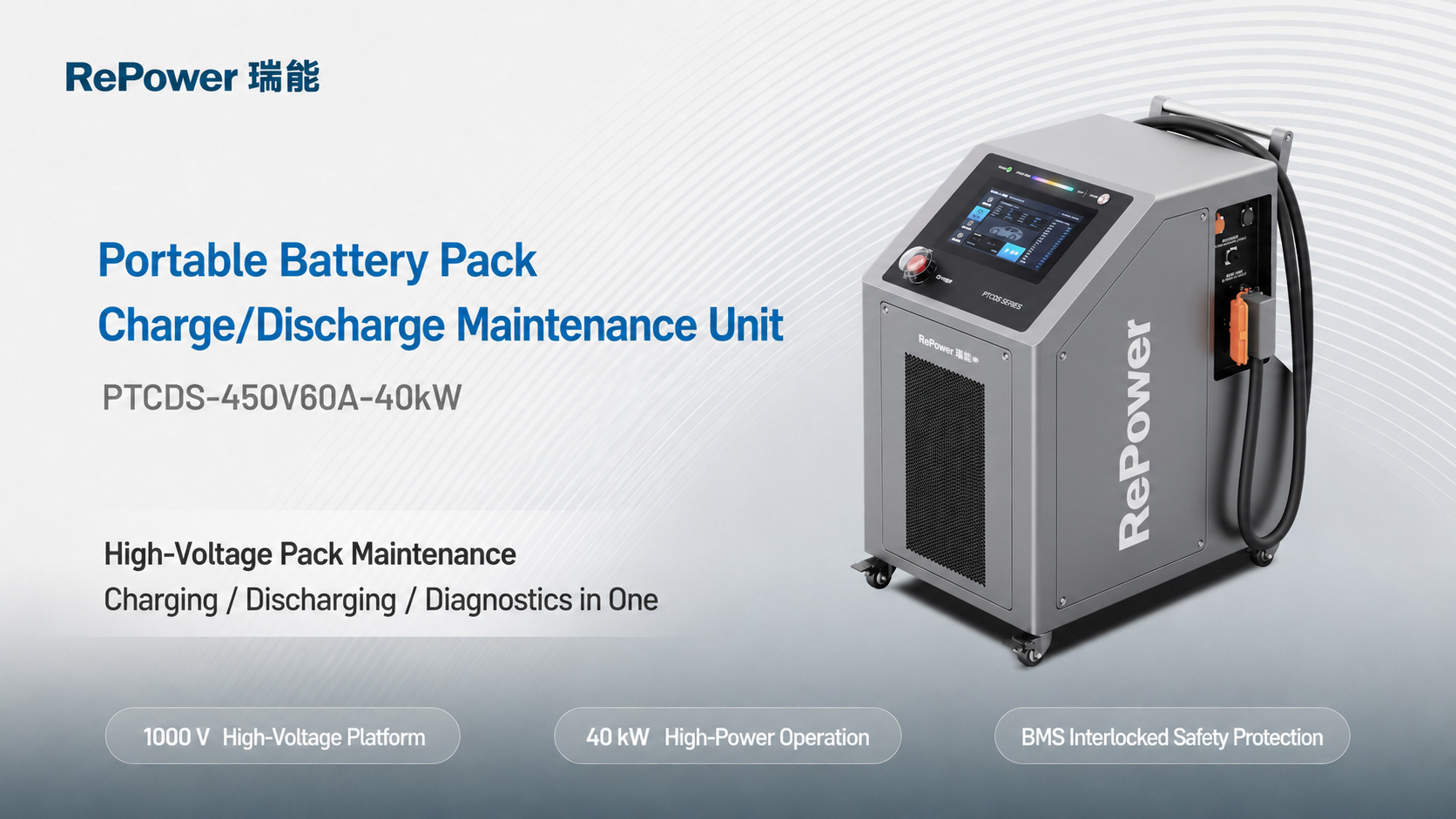
RePower Portable Battery Pack Charge/Discharge Maintenance Unit (complete-pack level): Designed for charge/discharge maintenance of complete vehicle batteries and battery packs, this system integrates charging, discharging, capacity evaluation, battery diagnosis, and safe energy discharge. Compared with module-level equipment, it delivers broader voltage coverage, higher operating efficiency, and more comprehensive safety control. The unit supports high-voltage battery platforms up to 1000V and addresses maintenance needs across a wide range of high-voltage battery packs. Output power reaches 40kW, significantly improving capacity testing and energy discharge efficiency while shortening warehouse operating cycles. Integrated CAN+RS485 dual-channel communication enables real-time acquisition of battery status information for fault analysis and state-of-health diagnosis. BMS data can be used directly as charge/discharge cutoff conditions to prevent overcharge and overdischarge and improve operational safety. During testing, the system monitors cell voltage, pack-terminal voltage/current, and charge/discharge capacity in real time, while one-touch parameter presets simplify operation. Multiple safety mechanisms include cell overcharge/overdischarge protection, pack-terminal overvoltage/undervoltage/overcurrent protection, and short-circuit, reverse-polarity, and overtemperature protection, supporting unattended operation. Mobile casters enable easy movement through warehouse aisles and across multiple workstations.
2.2 Safety Sampling and Electrical Performance Evaluation Equipment
The RePower Portable Power Battery Pack EOL Test System and Portable Energy Storage System Safety Inspection Equipment are designed for power battery storage, energy storage battery warehousing, and energy storage station O&M. Both systems integrate three core capabilities: electrical safety and insulation testing, electrical performance testing, and BMS communication testing, meeting the need for rapid and comprehensive on-site inspection.
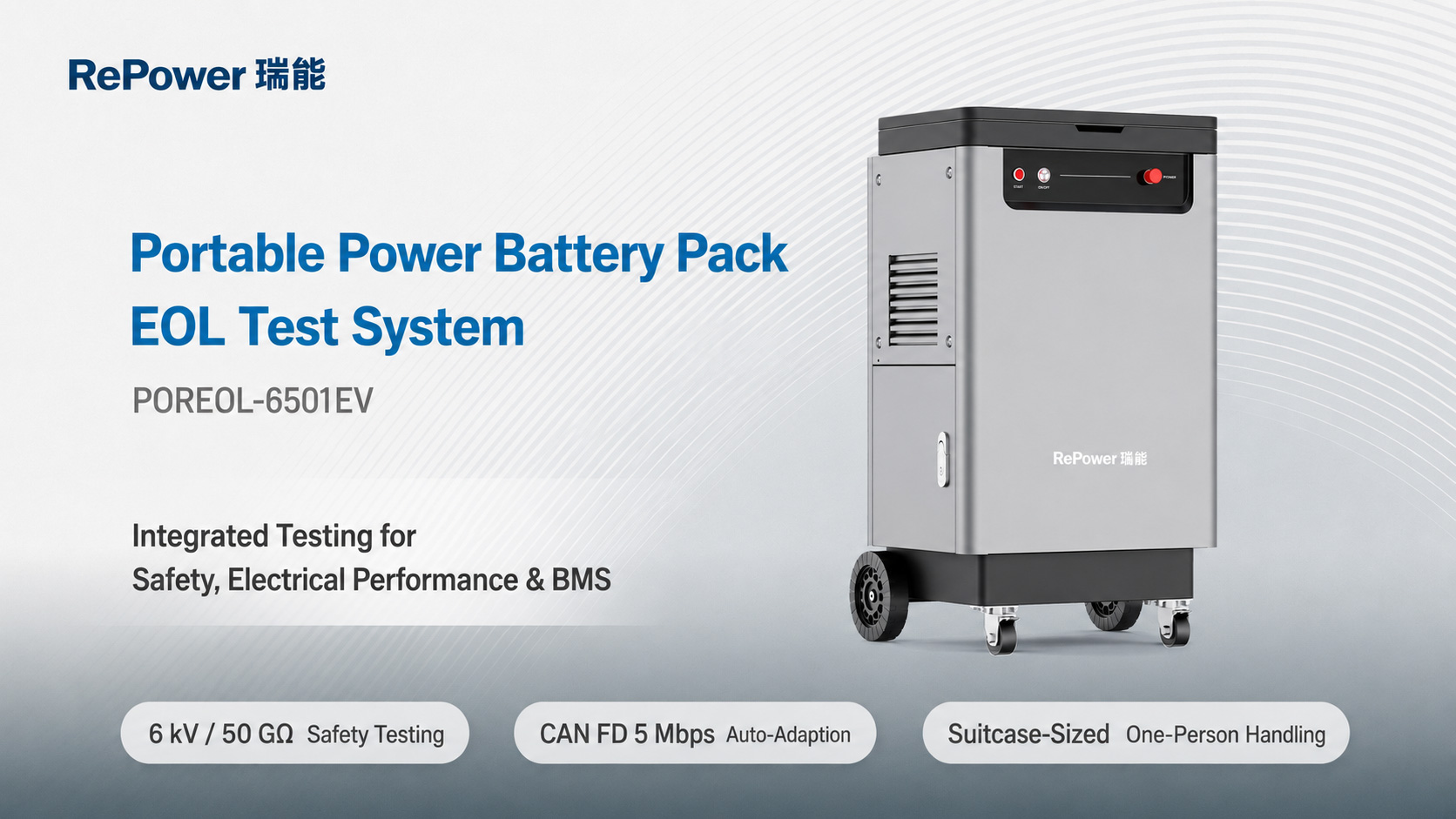
The equipment supports CAN FD communication at a maximum baud rate of 5Mbps. Its host-computer software can load and parse DBC files, allowing flexible adaptation to BMS protocols from different manufacturers. Voltage measurement accuracy reaches 0.01%F.S.; insulation resistance can be tested up to 6kV/50GΩ; AC withstand voltage output reaches 5kV/20mA; and DC withstand voltage output reaches 6kV/10mA, covering the electrical safety testing requirements of mainstream high-voltage battery packs. The complete system uses an integrated 28-inch suitcase form factor, with a built-in power supply and UPS providing at least 8 hours of standby time and at least 4 hours of continuous operation. If power is interrupted during operation, data are saved automatically and testing can resume. Inspection reports can also be generated automatically according to preset procedures. The user-friendly interface requires no specialized electrical background, enabling efficient and safe field O&M.
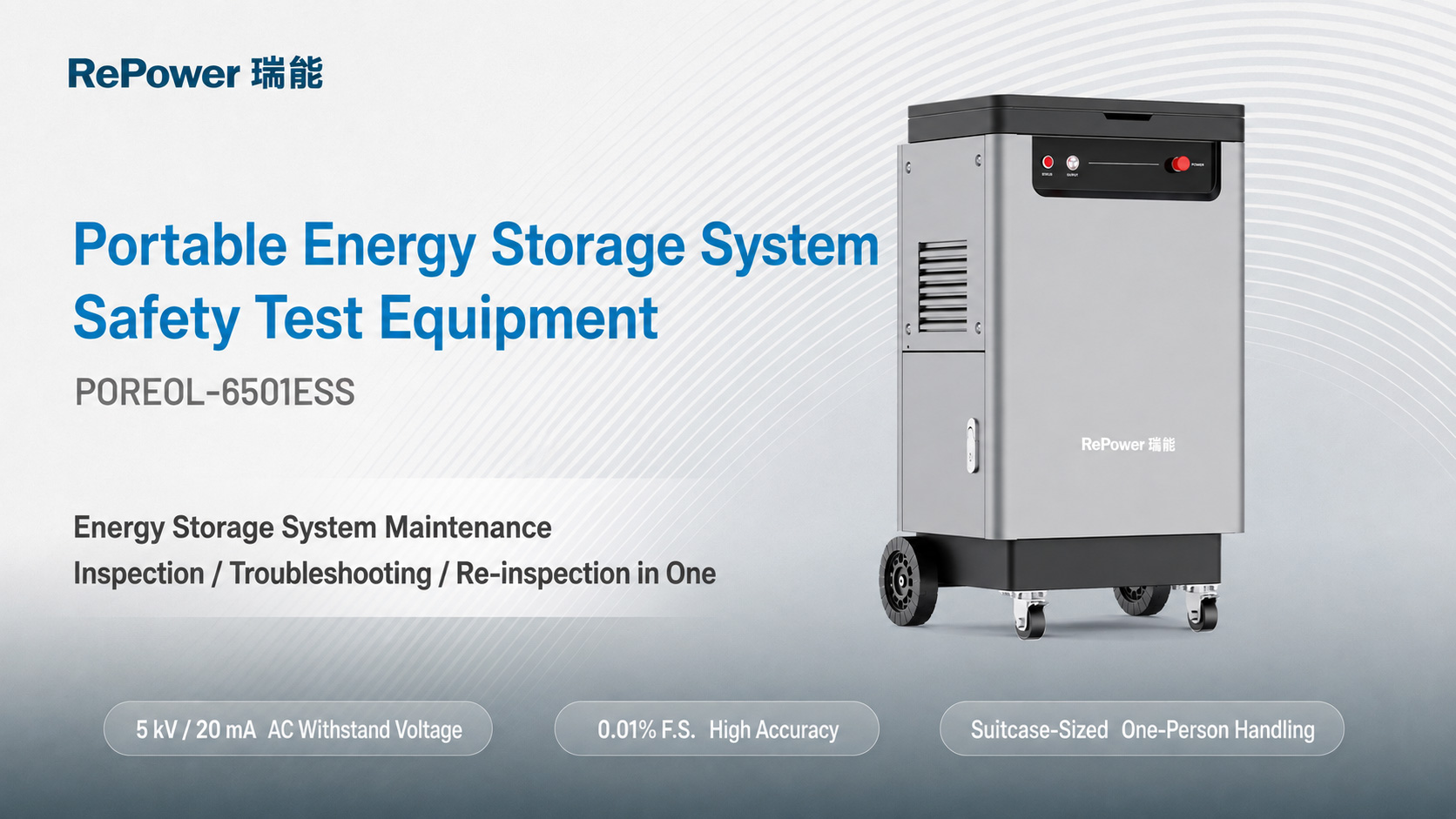
Charge/discharge records, sampling inspection results, and capacity calibration data from RePower portable equipment can all be stored locally and exported in Excel format or via a USB drive. This supports warehouse ledger archiving and cross-department sharing, enabling full traceability across inbound, in-storage, and outbound processes.
3. Typical Applications
Scenario 1: Finished-goods storage at battery plants. After battery packs leave the production line and enter storage, warehouse personnel periodically use the RePower Portable EOL Test System to sample insulation resistance and cell voltage deviation. Batteries stored for more than 90 days are activated and capacity-calibrated with the appropriate RePower portable charge/discharge maintenance unit selected according to voltage level. Test data are stored automatically and compared with historical records before shipment, while abnormal batteries are quarantined and withheld from delivery.
Scenario 2: Spare-parts warehouses at energy storage stations. Because energy storage spare parts may remain in storage for extended periods, operators periodically use RePower Portable Energy Storage Safety Inspection Equipment to sample insulation and electrical performance. The RePower Portable Battery Pack Charge/Discharge Maintenance Unit is used to activate and maintain battery packs, ensuring that spare units are ready for immediate use and remain in a reliable condition.
Scenario 3: Storage monitoring for returned power batteries. While customer-returned or recalled batteries await processing in a warehouse, periodic sampling inspections prevent further deterioration and preserve baseline data for subsequent responsibility assessment.
Scenario 4: Storage and transportation. For warehouse transport operations, the RePower Portable Battery Pack Charge/Discharge Maintenance Unit can reduce battery SOC to a safe range, lowering the risk level associated with high-voltage batteries.
The quality of a battery's storage period directly determines its performance after installation and the manufacturer's aftermarket costs. With portable charge/discharge maintenance equipment covering both modules and complete packs, portable power battery EOL test equipment, portable energy storage safety inspection equipment, and comprehensive data recording and export functions, RePower provides battery manufacturers and energy storage operators with end-to-end inspection capabilities for the storage stage. Every battery's storage period can therefore be documented, traced, and quality-controlled.
Learn more about RePower portable aftermarket maintenance equipment: https://www.repowerglobal.com/h-col-198.html

