
Formation and Capacity Grading: The Final Engineering Gate from Solid-State Battery Samples to Mass Production
Solid-state batteries areregarded as an important direction for the next generation of power batteries,and much of the industry's current attention is focused on advances in solidelectrolyte material systems. In industrial practice, however, manyparticipants are recognizing that after materials achieve progress in thelaboratory, downstream formation and capacity grading become a criticalengineering hurdle in converting solid-state batteries from samples intoproducts.
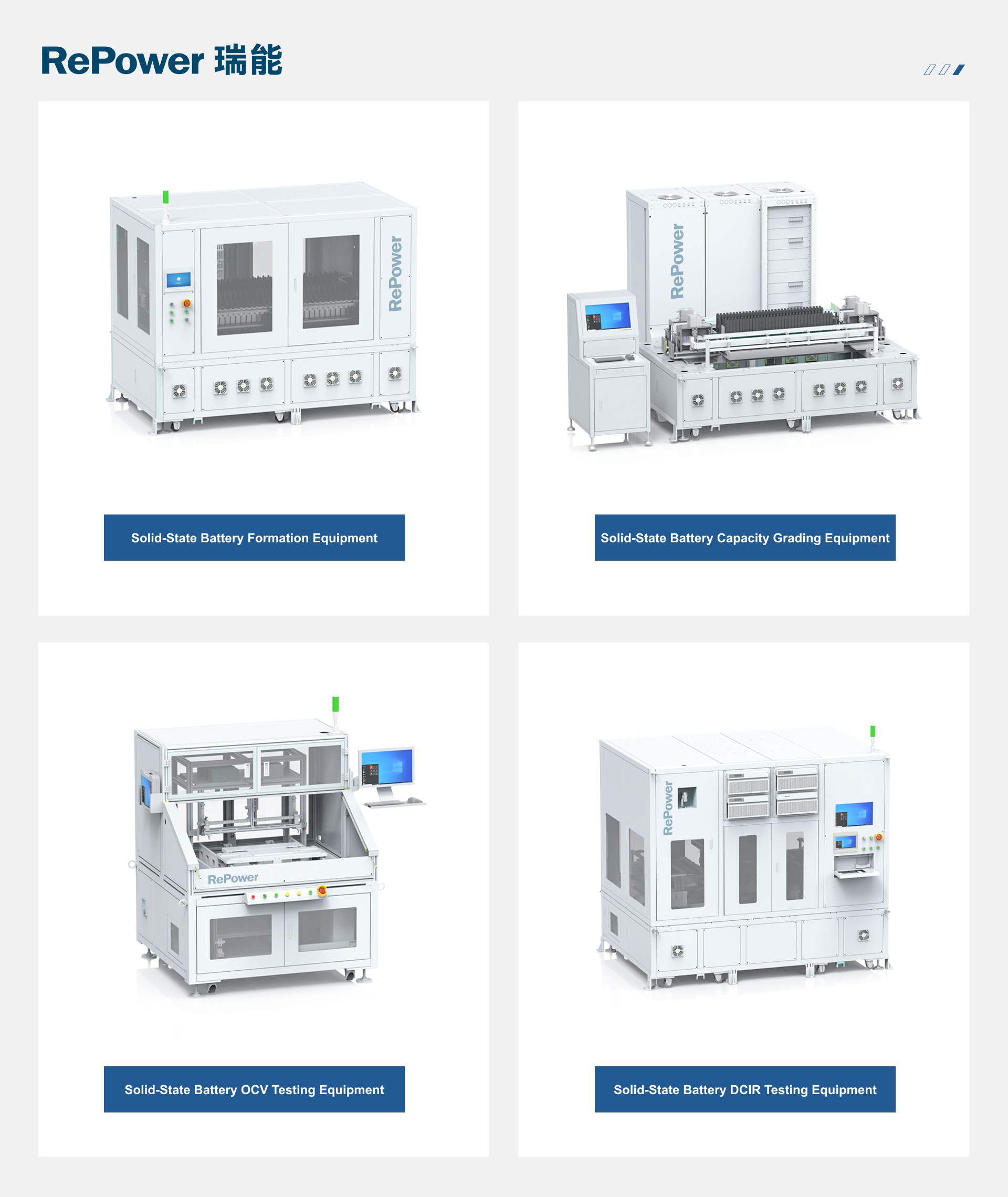
Unlike conventional liquid-electrolytelithium batteries, the unique characteristics of solid-solid interfaces insolid-state batteries create a new set of engineering challenges, includingpressure sensitivity, complex temperature-field control, and greater difficultyin electrical signal acquisition. Conventional lithium-battery formation andcapacity grading equipment cannot be directly reused for solid-state batteryprocesses. In conventional liquid-electrolyte lithium batteries, pressure,temperature, and electrochemical charge/discharge are relatively looselycoupled during formation and capacity grading. Under solid-state batteryoperating conditions, however, pressure, temperature, and electrical signalsare closely interdependent. Pressure changes the contact state of solid-solidinterfaces, while temperature changes further affect impedance andcharge/discharge behavior. Single-variable control cannot meet cell processrequirements. Coordinated mechanical, thermal, and electrical control hastherefore become a fundamental requirement in the design of dedicatedsolid-state battery equipment.
In practice, solid-state batteryformation must address several issues at once: how to apply pressure uniformlyand maintain it steadily; how to establish a stable, controllable temperaturefield within the chamber; how to reliably acquire voltage, current, andinternal resistance signals under complex operating conditions; and how toperform OCV, DCIR, and other tests for cell screening and evaluation. Theserequirements place higher demands on both hardware and control algorithmsacross the complete system.
With more than two decades ofexperience in battery testing and intelligent manufacturing, RePower hasdeveloped a complete solid-state battery formation and capacity grading line solutionthat has been successfully deployed at the factories of several leadingindustry customers. Integrating high-precision servo motors, stable temperaturecontrol, and AI-driven electrochemical strategies, the technology system spansmaterial R&D, cell prototyping, pilot validation, and high-volumepre-production. Innovative changes to equipment principles, hardwarearchitecture, and process adaptation provide comprehensive support from R&Dthrough manufacturing, helping solid-state batteries progress from thelaboratory to scaled mass production.
Built on coordinated hardware andsoftware design, RePower's solid-state battery formation and capacity gradingequipment addresses common industry challenges such as uniform pressureapplication and temperature-field control during formation. It captures cellcapacity, cycle characteristics, service life, and other indicators with highprecision, generating high-fidelity test data that supports process iteration,improves batch consistency, and helps transform samples into manufacturableproducts. Algorithms and software are as integral to coordinated control as thehardware. By working together, the hardware and software acquiremultidimensional state data simultaneously, giving R&D teams a datafoundation for process exploration. The complete equipment system uses amodular design to accommodate the changing test requirements of batterycompanies at different stages of R&D.
At present, RePower's dedicatedsolid-state battery formation and capacity grading systems and supporting testequipment, including individual units and complete line solutions, have beendelivered to customers. They serve battery manufacturers, vehicle OEMs, andinnovative solid-state battery companies in China and overseas, supporting partners'R&D and production-line development and providing equipment support for theindustrialization of solid-state batteries in China.
The industrialization ofsolid-state batteries remains at an exploratory stage, and engineeringchallenges across different technology pathways require continued work. In thiscontext, flexible, iteratively upgradable solid-state battery formation,capacity grading, and test equipment that evolves with cell processes throughindustry-chain collaboration is becoming an important route to the engineeringdeployment of next-generation battery technology.

